













































































































Rebar (nondo): grades, sizes and weight per metre
Published · Updated
Rebar, called nondo in Tanzania, is ribbed steel bar cast into concrete to carry tension. Under BS 4449 the preferred sizes run from 8 to 40 mm and all three grades, B500A, B500B and B500C, have a 500 MPa yield strength. A 12 mm bar weighs 0.888 kg per metre.
In stock in Zanzibar
See all 11 products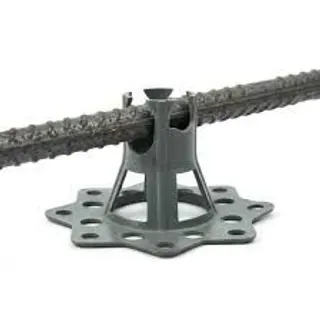
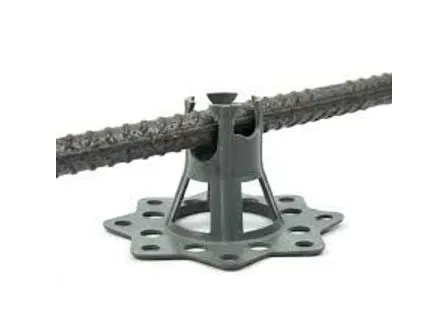
Plastic Rebar Chairs with Base (Rebar Spacers)
Plastic chairs that keep rebar and mesh at the set height above the formwork.
Order on WhatsAppTZS 2,630perpiece
Polypropylene Fibre for Concrete and Mortar
Order on WhatsAppTZS 15,100perkg


K11 Polymer Cement Waterproof Coating (Two-Component)
18 kg/barrelOrder on WhatsAppTZS 155,000perbucket




Rebar (nondo): what it does in concrete
Concrete is strong when squeezed and weak when pulled, so beams, slabs, columns and footings carry steel where the pulling forces are. That steel is rebar, or nondo as buyers in Tanzania call it: rebar reinforcing steel delivered as straight bars or coils and tied into cages and meshes on site. Steel reinforcement rebar does its job only if it is the grade and size on the drawings, sits where the drawings put it and has enough concrete around it.
Plain and ribbed bars, and the B500 grades
Reinforcement bars come plain (smooth round) or ribbed. Ribs grip the concrete; BS 4449, the British standard for weldable reinforcing steel, covers ribbed bar and coil in three grades that differ in ductility, not in strength.
| Grade | Yield strength Re | Tensile/yield ratio Rm/Re | Elongation at maximum force Agt |
|---|---|---|---|
| B500A | 500 MPa | 1.05 | 2.5% |
| B500B | 500 MPa | 1.08 | 5.0% |
| B500C | 500 MPa | 1.15 to below 1.35 | 7.5% |
Source: The Concrete Centre, Standards for reinforcement. For bars below 8 mm the B500A values are 1.02 and 1.0%.
Steel reinforcement bars made to the American standard are graded by minimum yield strength instead: ASTM A615 lists Grade 40, 60, 75 and 80, which are 280, 420, 520 and 550 MPa. The two systems are not interchangeable on a drawing, so the grade on the delivery note should match the one the engineer specified.
Rebar sizes and weight per metre
BS 4449 allows diameters from 6 to 50 mm and names 8, 10, 12, 16, 20, 25, 32 and 40 mm as preferred. Its mass table is the reference for steel rebar of any brand, because the mass per metre is calculated from the nominal area, not measured from one product.
| Diameter | Area | Mass per metre | Mass of a 12 m bar (calculated) |
|---|---|---|---|
| 8 mm | 50.3 mm² | 0.395 kg | 4.74 kg |
| 10 mm | 78.5 mm² | 0.617 kg | 7.40 kg |
| 12 mm | 113 mm² | 0.888 kg | 10.66 kg |
| 16 mm | 201 mm² | 1.58 kg | 18.96 kg |
| 20 mm | 314 mm² | 2.47 kg | 29.64 kg |
| 25 mm | 491 mm² | 3.85 kg | 46.20 kg |
| 32 mm | 804 mm² | 6.31 kg | 75.72 kg |
Source: BS 4449, table 7; the last column is our calculation (mass per metre × 12) for bars sold in 12 m lengths. The same arithmetic gives about 1,126 m of 12 mm metal rebar per tonne (1,000 ÷ 0.888). Sellers quote by the bar or by the tonne, and these figures convert one into the other; listed bar prices are on the rebar price page.
How to check reinforcement bars on delivery
BS 4449 gives a buyer several things to check without a laboratory:
- Designation. The standard’s form is “Bar 40 × 12000 BS 4449 Grade B500B”: product, diameter × length in mm, standard, grade. Ask for it on the delivery note.
- Rib pattern. The grade is identified by the arrangement of the transverse ribs. In B500B, one rib series runs at a contrary angle to the others; in B500C, the ribs within each series also alternate between a higher and a lower angle.
- Maker’s mark. Every bar must carry identification marks for the manufacturer.
- Weight. The mass per metre may deviate by no more than ±4.5% for bars over 8 mm and ±6.0% for 8 mm and smaller. A 12 m length of 12 mm bar below about 10.2 kg falls outside that band (our calculation).
- Length. The permitted deviation is +100 mm / −0 mm on the ordered length.
- Origin. Bars re-rolled from finished products, or made from steel of unknown history, are outside the standard.
These checks apply to rebar and steel bought for any job; they do not replace the engineer’s inspection of the fixed cage before concrete goes in.
Slab reinforcement: bar spacing and cover
Steel reinforcement in a slab is laid out by the structural engineer, but the limits behind the drawings are public. The Eurocode 2 detailing rules summarised by The Concrete Centre set the maximum spacing of main bars at three times the slab depth and no more than 400 mm, and of secondary bars at 3.5 times the depth and no more than 450 mm. In areas of maximum moment the main bars close up to twice the depth, 250 mm at most.
The same rules keep bars apart by at least the largest of: the bar diameter, 20 mm, or the maximum aggregate size plus 5 mm, so the concrete can flow between them. Cover to a main bar must be at least its own diameter plus an allowance for deviation, usually 10 mm. Holding that cover while concrete is poured is the job of chairs and blocks — see rebar spacers and cover blocks. Kitovu stocks Plastic Rebar Chairs with Base (Rebar Spacers) in Zanzibar for that job. Top slab reinforcement needs its own supports at the right height, as the bottom mat does. Where the slab is divided by joints, the drawings show which bars run through each joint and which stop; the joint types are explained on the expansion joint page.
Steel reinforcement and other materials
Structural steel sections carry loads on their own, without concrete around them; the differences between the main shapes are on the I-beam and H-beam page. Fibres mixed into concrete control shrinkage cracking, but the Sika data sheet for one polypropylene fibre states plainly that it should not be used to replace structural steel reinforcement; more on that on the concrete fibre page.
Questions
What is rebar in construction?
Steel bar placed inside concrete before it is poured, so that the steel carries the tension and the concrete the compression. BS 4449 bars are ribbed and come in grades B500A, B500B and B500C, all with a 500 MPa yield strength.
Why is rebar important in construction?
Concrete cracks under tension, and the bars bridge those cracks. Their size, grade, spacing and cover come from the structural drawings; the Eurocode 2 rules quoted by The Concrete Centre, for example, limit main bar spacing in slabs to three times the slab depth and 400 mm.