













































































































Rebar spacers and cover blocks: types and how many
Published · Updated
Rebar spacers and cover blocks hold reinforcement at a set distance from the formwork or ground, so the steel ends up inside the concrete cover the drawings ask for. Under Eurocode 2 rules that cover is at least the bar diameter plus a deviation allowance, usually 10 mm, as The Concrete Centre summarises.
In stock in Zanzibar
See all 11 products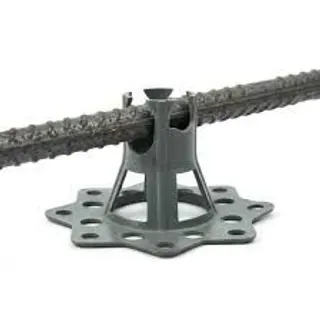
Plastic Rebar Chairs with Base (Rebar Spacers)
Plastic chairs that hold rebar at the right cover while concrete is poured.
Order on WhatsAppTZS 2,630perpiece
Polypropylene Fibre for Concrete and Mortar
12 mm polypropylene monofilament fibre against plastic shrinkage cracks, 0.9 kg per m³.
Order on WhatsAppTZS 15,100perkg
K11 Polymer Cement Waterproof Coating (Two-Component)
18 kg/barrelOrder on WhatsAppTZS 155,000perbucket





What rebar spacers and cover blocks do
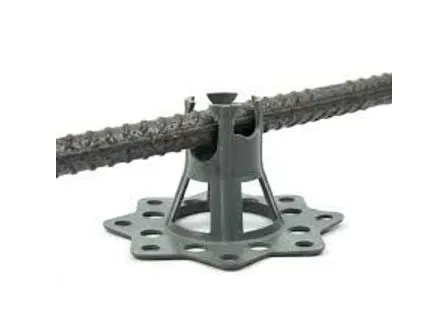
The concrete between the steel and the outer face is the cover, and it is what keeps the bars from corroding. A spacer fixes that distance while the concrete is poured: under the bottom mat of a slab, at the sides of a beam cage, between a wall bar and its formwork. Without concrete cover spacers, nothing holds the bars at the cover depth while the concrete is placed.
The Eurocode 2 detailing rules summarised by The Concrete Centre set the cover to a main bar at no less than the bar’s own size plus an allowance for deviation, usually 10 mm. In the UK, spacers in reinforcement are covered by BS 7973: part 1 for the products themselves, part 2 for fixing, spacing and tying them so cover holds under normal construction loads.
Types of reinforcement spacers
The quantities below are one supplier’s guideline, from the Betonstaal guidelines for spacers; the engineer’s specification takes precedence.
| Type | Where it goes | Cover range | Guideline quantity |
|---|---|---|---|
| Small concrete blocks | under a beam or ground-beam cage | 25–55 mm | 3 per 1,000 mm of cage |
| Large concrete blocks (spacer blocks) | under slab mesh | 25–100 mm | 3 per m² |
| Concrete setting rails | under slab mesh, soft or hard base | — | 2.5 per m² |
| Plastic floor spacers with a large base | under slab mesh | 20–70 mm | 1.5 per m² |
| Plastic rings | cage to rigid formwork (timber, steel), bars 4–12 mm | — | 6 per 1,000 mm of cage |
| Plastic cones | cage to soft formwork, bars 4–16 mm | — | 6 per 1,000 mm of cage |
| Long line spacers, 2,000 mm | under slab reinforcement | — | floor area in m² × 0.85 |
| Wall (duo) spacers | between two mesh layers of a wall | — | not given |
The guide explains the lower count for large-base plastic rebar chairs by their wide bearing surface, which keeps them stable. The Plastic Rebar Chairs with Base (Rebar Spacers) that Kitovu stocks in Zanzibar are chairs of this base-plate kind. For walls in aggressive environments, such as slurry pits, it recommends concrete spacers over plastic ones; for soft ground it lists rails and long line spacers made for soft substrates.
How many spacers per square metre
Take a ground slab of 10 × 8 m, which is 80 m². At three large concrete blocks per square metre it needs 240 blocks; at 1.5 large-base plastic spacers per square metre, 120 (our calculation from the Betonstaal guideline). The cover block price page turns those counts into a cost. A beam cage 6 m long on small concrete blocks needs 18, by the same guideline.
Each rebar spacer has to hold its position until the concrete sets; BS 7973-2 writes its fixing rules for members under normal construction loads, not only for the weight of the steel.
Choosing the cover: what sets it
The cover itself comes from the structural design, not from the spacer catalogue. Eurocode 2 ties minimum cover to the exposure class of each member. Eurocode Applied’s summary of EN 1992-1-1 describes class XS1 as concrete exposed to airborne salt but not in direct contact with sea water, typical near the coast, and XS3 as the tidal, splash and spray zones of marine structures. A building on or near a shoreline can therefore fall into a stricter exposure class than the same building inland.
Once the cover is known, order concrete cover spacers of that height for each position. The reinforcement itself, with bar sizes and weight per metre, is on the rebar (nondo) page, and the moulds the spacers sit against are covered under formwork and shuttering.